An indication of a strong mindset to change Yobe State’s unflattering education story, Governor Mai-Mala Buni quite
early in his tenure unfolded vision to challenge an alarming nightmare the sector has for many decades represented.
Governor Mai-Mala Buni of Yobe State has sent a strong signal early in his tenure by unfolding his education agenda.
Since 2015 till date, Yobe State has consistently lagged behind other states in WAEC and NECO. From SUPREMACY Magazine
checks, in 2015, for example, only 646 candidates out of the 10, 807 candidates that sat for WAEC ‘passed,’ that year.
But Governor Mai-Mala Buni would have none of that. On climbing the executive saddle, he immediately declared a state of
emergency on primary and secondary education in the state and stressed that his new administration will sharply focus on
reversing the unflattering trend.
A former national secretary of the ruling All Progressives Congress (APC), Buni revealed that one of his
administration’s main focus in education is to “reinvent the teaching profession.” He also paid homage to the preceding
government’s effort in the education sector and pledged that a lot more needs to be done.
His words: “For all our investments in education over the years, for all the effort of teachers and parents across the
state, a lot still remains to be done. Our education system is still not where it is supposed to be. We still have so
much work to do.
“First, we all know that the performance of a majority of Yobe students in various national examinations, including SSCE
and NECO, is not very impressive. Second, because of the often-dismal performance of students at the primary and
secondary school levels, Yobe has remained unable to fill our quotas in various institutions of learning and in
significant areas of specialization, such as medicine, computer science, and engineering.
“Third, as a result of the above, we are still a long way from getting an adequate number of indigenous professionals
that our state needs to provide much-needed social services.”
Against the background of the enormous challenges facing the sector in Yobe State, Governor Buni restated his unswerving
resolve to go the whole hog to change Yobe’s education narrative.
According to him, “I declared an emergency in our primary and secondary education during my inauguration speech on May
29, 2019. A declaration of an emergency is an admission that things are not where they are supposed to be.
“It means that the familiar perception of the problems that confront us must be creatively challenged. Most importantly,
it is a commitment to do all that is necessary to reverse the present order of thing to suspend the bureaucratic
impediments and other bottlenecks that stand in the way of achieving our urgent goal – the goal of providing the best
possible education for our children.”
To address the problem headlong, Governor Buni convened the first ever Yobe Education Summit in Damaturu. The summit
gave the governor the opportunity to share concerns about the development indices of the state as it pertains to
education.
During the summit, Governor Buni also left few in doubt that he is a realist and urged that related unscientific
assumptions must be discarded.
His words: “First we must avoid the temptation to assume that our education challenges can be addressed simply by
throwing money into the problems in the sector. If we do not have good ideas, if we do not identify specific
medium-to-long term trends that affect overall outcomes, our schools would remain in the same place even if we budget
everything we have in the state into them.
“Secondly, we must avoid the slander that people go into teaching because they have nothing better to do with their
lives. Teaching is important. I dare say that we could not have been here today without the support of good teachers.
“It is, therefore, time we recognise the real importance of teachers and give them the respect they deserve. But it is
also important that teachers themselves recognize their worth in society by taking their jobs more seriously, and by
never failing to teach their classes without any valid excuses.
“I want to assure you that my administration is committed to reinventing teaching as a profession in Yobe State. So, in
the coming weeks and months, we intend to roll out different incentives to equip our teachers to do better.
“This will entail, but will not be limited to, providing more opportunities for those who need re-training to re-train,
organizing workshops and seminars on global best practices in teaching, and making the school environment more conducive
for teaching and learning.”
We also know that education is a human development imperative. It is therefore, pertinent that we explore other human
development challenges that often impede our capacity to provide a qualitative education for our children. Issues such
as good nutrition for children are important, because a malnourished child is simply ill-equipped to internalise
learning patterns.
The governor further stated that, “we will partner our traditional rulers and community leaders to make sure that school
enrolment improves. This is because across Yobe today, overall school enrolment for children between the ages of six and
10 is significantly lower than it should be when you take population growth and other demographic factors into
consideration. This has to change”.
Equally, parents must be actively involved in their children’s education as well. They have to show interest and let
their children know that they are following their progress in school.
Regarding infrastructure, Buni unveiled plans to build three model primary schools in the three senatorial zones of the
state – with a long term plan to cover the entire 17 Local Government Areas all in an effort to re-position Yobe on the
global educational map.
He said: “Currently, our school infrastructure is overstretched, especially in the urban areas such as Potiskum, Nguru,
Gashu’a, Gaidam and Damaturu.
“To get our schools fully retooled and redesigned for the success we want them to achieve, we must make huge investments
to improve teaching and learning facilities and to renovate classrooms, hostels, libraries and laboratories”.
He further stated that, “we will also seek partnerships with the federal government, the United Nations and other
governmental and non-governmental organisations so that together, we can bring all the much-needed investments to
turnaround Yobe’s education system.”
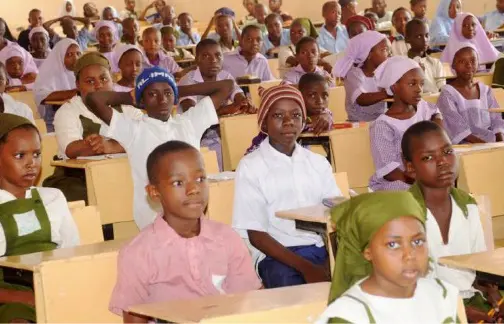
New Vision For Education In Yobe
Related Articles


Comments (2)
I think the governor’s approach shows a clear understanding that fixing education goes beyond just funding—it requires improving teachers, infrastructure, and student support systems together.
To me the plans are ambitious and necessary, the real test will be consistent implementation, especially in improving exam performance and increasing school enrollment across the state.