The UK-Africa Investment Summit took place with the hype and fanfare with Nigeria counting gains already.
The UK turned its charm on African leaders, which included President Muhammadu Buhari, in January, welcoming 21 heads of
state to east London to meet with financiers, trade envoys and investors for the first UK-Africa Investment Summit.
Declaring the summit open, UK prime minister Boris Johnson pitched the UK as “Africa’s partner of choice” in
international trade as the country leaves the European Union (EU) and prepares to forge its own trade agreements.
Deploying the jovial personality that helped him to secure a firm victory in the UK’s December election, Johnson
prompted laughter by underlining this point with an Akan proverb he had “picked up in Ghana”.
“All fingers are not the same,” he said, holding up a hand, “and all countries are not the same. The UK boasts a breadth
and depth of expertise that simply cannot be matched by any other nation”. While deliberately ham-fisted, the speech
hinted at the plans being laid in the UK, and the City of London in particular, to cash in on trade with a continent
containing some of the world’s fastest growing economies. However, the reality and potential for UK trade on the
continent remain limited.
“We’re now in 23 markets in Africa, we’ve extended out into Guinea, Mauritania, Rwanda and Zimbabwe over the last 12
months as part of this invigorated focus on trade and investment in Africa” This was made known by Emma Wade-Smith,
Britain’s Trade Commissioner for Africa. The trade arrangements with African countries and economic blocs that the UK
has been party to as a member of the EU will continue until the end of a transition period ending on 31 December 2020.
A continuation of the largest of these agreements, SACU + 1 (the Southern African Customs Union plus Mozambique) – which
accounted for $12.6bn worth of trade last year with the UK – have been concluded. A UK treaty with Eastern and Southern
Africa, which covers Mauritius, Seychelles, Zimbabwe, and Madagascar, have also been struck.
“We’ve also transitioned the association agreements in Morocco and Tunisia, and we’re working really hard on the
remaining network of agreements and hope that some of the political conversations we’ll be able to have at the summit
will enable us to make a bit more progress on that,” says Wade-Smith.
Negotiators are still hammering out trading terms with Egypt, Ghana, Côte d’Ivoire, Cameroon, Kenya and the East African
Community, she says.
Wade-Smith also pointed out that the UK have already passed legislation to transition the EU’s General Scheme of
Preferences, which allows exporters from developing countries to pay less or no tariffs on a range of goods including
almost everything except arms. This means that “duty free, quota free access exists for African exporters to get access
to UK markets so that our consumers can also have the opportunity to buy more high-quality African goods, than they
currently do,” she said.
Despite all this, UK-Africa trade lags behind, than that of other nations. UK trade with Africa increased 7.5% over the
last 12 months to $102bn, with a focus on machinery, oil and gas, tourism and professional services, but it languishes
far behind that of China, the continent’s top trading partner at $208bn in 2019. In a series of tweets to coincide with
the summit, Charlie Robertson, global chief economist at Renaissance Capital pointed out that the UK’s trade with Africa
has fallen considerably since the colonial era and is now much less important for the continent’s major economies. He
said that the UK once accounted for 70% of international trade with Africa’s biggest economy, Nigeria, but since
independence the figure has collapsed from just under 50% to 3%. Africa’s second largest economy, South Africa, “has
also re-directed its trade from over a third with the UK to less than 1/20th of its trade now”, while trade with Egypt
collapsed after the UK invaded Suez in 1956 and now stands at about 4%. In East Africa, home to some of the world’s
fastest growing economies, in 2019 – Ethiopia, Rwanda and Kenya – the story is similar. The UK is responsible for just
3% of Kenyan trade. Robertson also points out that UK-Africa trade also accounts for just 3% of the UK’s total global
trade.
UK exports to the continent were down to 2.6% in 2019, from 4.1% in 2012, according to the UK’s Office for National
Statistics. It is “impossible” that Africa could replace the EU as the UK’s main trading partner, according to John
Ashbourne, senior emerging markets economist at Capital Economics.
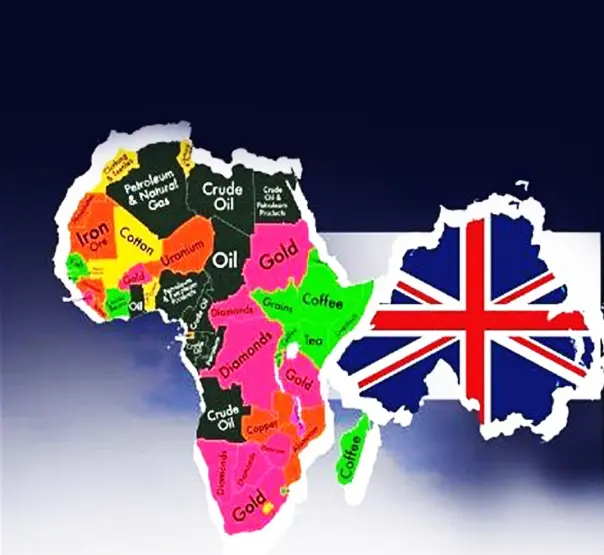
Whereas China imports African raw materials like copper, iron ore, gas, and oil to power its manufacturing economy,
Britain mostly imports consumer goods, thus limiting available imports from the continent. UK needs and African produce
simply aren’t complementary, Ashbourne explains.
“The optimistic take would be that there’s a big potential for growth, but realistically most of what Africa exports is
commodity products that the UK doesn’t really need,” he stressed. “There’s a lot of British businesses that do work in
Africa but if you’re looking at the most important trading relationships the UK has, even Africa altogether is just not
going to be one of the important ones, compared to trade with the US, China or the EU.”
Nevertheless, the emergence of the African Continental Free Trade Agreement offers opportunities for the UK and Africa
to better organise their trading relationships, according to Ebba Kalondo, spokesperson to the chair of the African
Union Commission: “The African Continental Free Trade Area agreement is firstly important to boost intra-African trade
but it also presents a historic opportunity for continent to continent trading, including with countries like the UK.”
Will Brexit benefit Africa?
Despite disappointing trade volumes, the UK government believes that Brexit holds the promise of improved visa access
for citizens of African countries and opportunities in exports, finance and Africa’s growing consumer markets.
Speaking the day after the summit, where the UK had pitched $1.7bn in investment deals to his country, President Uhuru
Kenyatta of Kenya called Brexit a “blessing in disguise”. “I must admit that some of us are not keen on a Brexit
situation, but I must also say we are glad that it has happened,” he said. “I think there is huge potential to re-ignite
once again the partnership and the investments that were actually the driving force of the global economy.”
The arrival of African companies in London could also help breathe life back into the UK’s lackluster stock market,
which has suffered from a series of high-profile flops, scrapped listings and Brexit uncertainty. With 110 African
companies already listed on the London Stock Exchange, with a total market capitalisation of over $175bn, Africa offers
significant potential for an uptick in the bourses’ fortunes. It is among the strategies of the new British government
to make more inroad into Africa where it has some of its most viable former colonies: like Nigeria, Kenya, Ghana, among
others.
The UK-Africa Investment Summit on 20 January 2020 laid the foundations for new partnerships between the UK and African
nations based on trade, investment and shared value.
The UK is already providing crucial expertise to enable African countries to raise funds from the international markets
in their own currencies. This means that they can attract valuable long-term investment while being protected from
exchange rate fluctuations. Again, we want to do more. The UK-Africa Investment Summit of 20 January will mark the
beginning of a step change in the focus and effectiveness of UK-Africa partnership.
As for Africa’s biggest economy, Nigeria, four British companies recently signed business deals with the country on the
sidelines of the inaugural UK-Africa Investment Summit in London. The deals were among the several others sealed between
UK companies and their African partners.
In the case of Nigeria, Low Energy Designs won an export contract to install street lighting in Oyo State while Savannah
will invest £315 million in the acquisition and investment of Inga’s assets in Nigeria. Another British company Tex ATC
is expected to install five airport control room towers worth £2 million in different parts of Nigeria while Trilliant
got a deal to install £5 million of Smart Metering for Abuja DisCo.
Several other deals were expected to be signed with African and UK businesses committing investments expected to reach
into the billions.
“Africa represents a huge opportunity for UK businesses, so it’s brilliant to see so many British firms paving the way
in trading and investing in the region today to drive growth, create jobs and boost vital infrastructure,” Secretary of
State for International Trade, Liz Truss MP said.
“We want the UK to be the investment partner of choice for African nations, and our world-leading expertise in finance,
tech, and innovation, makes the UK and Africa natural partners for prosperity”.
Before the opening of the summit Nigeria’s President Muhammadu Buhari lobbied the British community to invest in the
Nigerian economy. “For my country, greater UK engagement in its economy would bring jobs to under-tapped sectors, such
as agriculture and manufacturing,” Buhari said in an opinion published in The Guardian ahead of the UK-Africa Investment
Summit in London.
“Millions of highly skilled, English-speaking but underemployed young people, are eager to work but without the
opportunities that foreign investment can bring to create jobs and build businesses”. The UK said the deals signed show
how “we are building on that to secure a lasting commercial partnership of mutual benefit.”
President Buhari has since returned from the Summit. During the trip, the president met with British Prime Minister,
Boris Johnson and brought him up to speed with developments in Nigeria. The Nigerian leader told Mr Johnson about the
efforts of his administration in the agricultural sector, saying it has led almost to self-sufficiency in rice and other
grains production.
According to him, Nigeria has saved billions of naira in foreign exchange and the efforts are now deployed in other
areas of development. On the war against insurgency, President Buhari said things were a lot better, stressing that the
Nigerian government is making efforts to disabuse the minds of the people on the true philosophy of Boko Haram. Prior to
the president’s trip, his Special Adviser on Media and Publicity had said that with the expected take-off of the African
Continental Free Trade Area in mid-2020, the London Investment Summit was to provide Nigeria with the opportunity to
project itself as a leading investment destination for new industries.
He also said the summit would deepen Nigeria-United Kingdom investment ties as Africa currently represents just two per
cent of British trade activity, with Nigeria accounting for only10 per cent of that total.
Nigeria reaps from UK-Africa Summit
Related Articles


Comments (2)
The UK-Africa Investment Summit shows a growing attempt by Britain to re-position itself economically after Brexit, but the reality remains that UK trade with Africa is still relatively small and cannot easily compete with major partners like China or the EU.
For Africa, including countries like Nigeria, the summit presents opportunities for foreign investment and job creation, but long-term benefits will depend on whether these deals translate into real industrial growth and not just short-term agreements.