
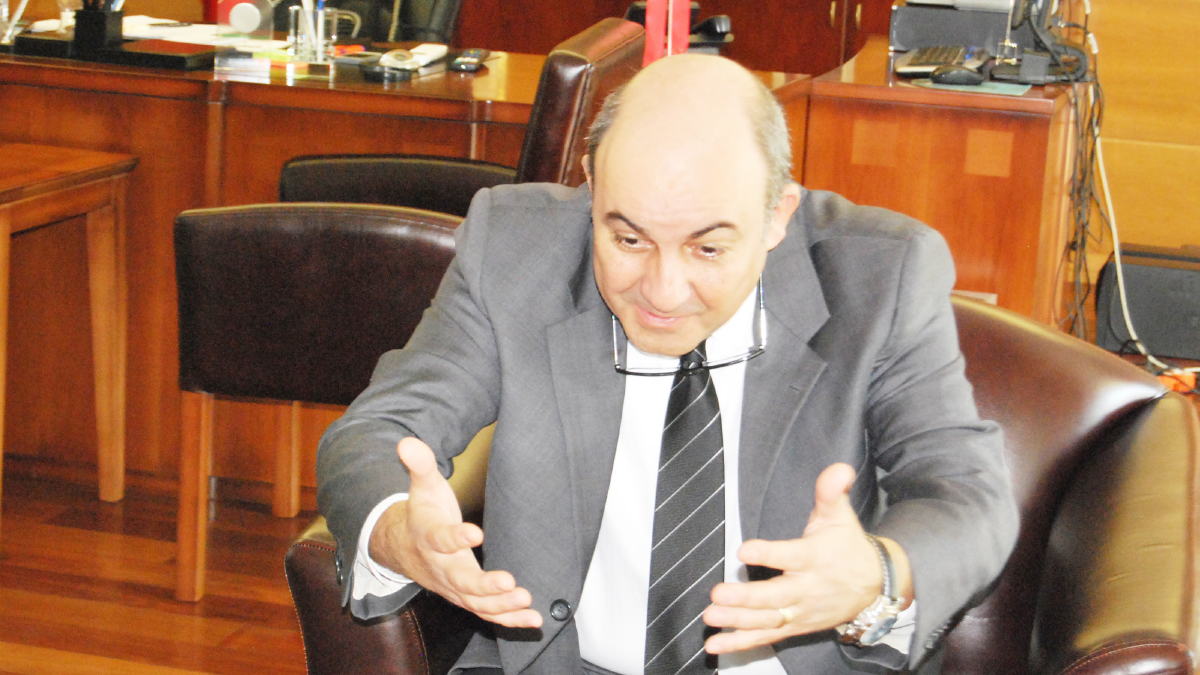
My Nigerian Story – Ambassador Hakan Cakil
With 28 years of sterling diplomatic career tucked under his belt, the Turkish Ambassador to Nigeria, His Excellency
Hakan Cakil took time off a busy schedule to speak with PRINCESS ABIGAIL AMALAHA and LOUIS ACHI. Over Turkish warmth and
tea, he opens up on his diplomatic achievements in Nigeria, challenges, favourite meal, little known aspects of the
Turkish-Nigerian story and more.
Please could you give an overview of your ambassadorial tour of duty in Nigeria?
Nigeria has a very important partnership with Turkey. We consider Nigeria as our strategic partner in sub-Sahara Africa.
Just after Nigeria’s independence, Turkey came and opened her embassy in Lagos. Her natural resources, with its
strategic location and its very rich human resource make Nigeria a very important country to us.
I have been here as Turkish ambassador in Nigeria for two-and-half years. When I look back I observed that we have done
a lot of considerable things. First of all, our total trade volume is approximately US$1.2 or US$1.4 billion. We are
importing crude oil, LNG, Sesame, and palm oil from Nigeria. In return, we are exporting some textile products, some
machinery, spare parts, and some construction materials to Nigeria.
To be honest with you, bilateral trade is in favour of Nigeria because we are importing a lot of LNG and crude oil from
Nigeria. But we are happy to engage in deep commercial relationship with Nigeria. But since the oil sector in Turkey is
privatized, therefore we don’t know how much crude oil our private sector has been importing from Nigeria, but when we
observe our total trade volume, we are importing a lot from Nigeria.
Politically, we have been enjoying excellent relations with Nigeria. Since I came here, we have exchanged two
presidential visits. In March 2016, the Turkish President came to Nigeria, and October 2017, His Excellency President
Muhammadu Buhari, paid an official visit to Turkey. It is a record for both countries to exchange presidential visits
within a period of just one-and-half-years. The last presidential visit between our countries was in 2011, and after
that, we had other ones in 2016 and 2017. I did my best to realize the last two presidential visits. Our presidents had
excellent relationship.
We have been exchanging numbers of technical visits between our countries. Since I came here, members of Turkish
delegation, from finance to health sector, came to Nigeria, and also we have lots of Nigerian delegation in Turkey.
For instance, last week, we had a Nigerian delegation to Turkey. This week, from Monday to Wednesday, until last night,
we had a number of Turkish delegation – they just left. In the next two weeks, we will be having another Nigerian
delegation to Turkey. So, as an ambassador, I am exerting every effort to further enhance our bilateral relationship
because we love Nigerian people.
The field of education is really important to us. When I first came here, I recognized that we do not have enough
Nigerian students on Scholarship in Turkey. We are providing official scholarship in Turkey for students from Nigeria
and sub-Sahara Africa.
Within two educational years - 2016 and 2017 and this year 2018, we have provided 60 scholarships to Nigerian students.
They are now studying in Turkey, under the Turkish government scholarship in very high competitive state universities.
Furthermore, we have approximately 1,500 Nigerian students who are studying in Turkey in different universities on their
own. We are very happy to have them because the academic performances of the Nigerian students in Turkey are highly
commendable. They are very good academically.
As an ambassador, I am trying to do my best to increase the number of Nigerian students in Turkey. To this end, I
invited some private universities to Nigeria. They came, and I asked them to visit the major states in Nigeria,
including Abuja, Kano, Lagos, Port Harcourt, to present themselves. They started to do this since last year. They are
going to Kano, Port Harcourt, Lagos, Abuja, to meet with some students’, they met with some officials of the National
Universities Commission (NUC), and some other officials.
And the number of Nigerian students who are going to Turkey is going high. Only last year, 2017, 161 Nigerian new
students joined this 1,500 Nigerian students studying in Turkey. Last year the number increased by 181. We issued 161
Visas, and also we are receiving lots of Nigerian students also in the Republic of Cyprus. Approximately 7,000 Nigerian
students are studying in universities in the Cyprus which is an independent state close to Turkey. So, in the 2018/2019
educational year, we’ll provide 50 scholarships for the Nigerian students, and the number will increase steadily.
When I talked to Turkish universities, they are happy with the academic performance of Nigerian students. Some Nigerian
students after they finish their study, they stay as academicians in the universities because they prefer to work in
Turkey. We have Nigerian medical doctors who studied in Turkish medical schools working in Turkey, and we have Nigerian
engineers also working in Turkey.
Last year 2017, we issued approximately 4,000 Visas to Nigerian citizens to travel to Turkey and we are providing a
facility for Nigerian citizens who have US/UK Visas.
What have been your major challenges since arrival in Nigeria?
Of course, always there are challenges in international relations. There are challenges between the governments. But
these are what diplomats or ambassadors are for. So we have good relationship with Nigeria, and when we have some
challenges, we engage in discussions with our Nigerian counterparts and solve those challenges quickly. So, I can say
that both countries/both governments have very strong resolve to deepen their relationship, so whatever we have for
discussion, some issues that you may describe as challenges, we solve them with Nigerian authorities. So, as a Turkish
ambassador, Nigeria is quite a comfortable and beautiful country. We are happy to work with Nigeria on every field.
With your two-and-half-year tour of Nigeria, have you been able to learn any Nigerian language?
A little bit, because you Nigerians speak English. You don’t feel obliged to talk in local languages, for instance in
Igbo language, I know ‘ututu oma,’ (laughter) and Ika aro, in Yoruba. Since my personal assistant is a Yoruba lady, I
know some Yoruba words. Sometimes, I ask her to write me in Yoruba. For instance, when I want to extend my
congratulations or greetings to a friend on his or her birthday; I do it in Yoruba language. So, I learnt some few
words. But I think I should learn more.
From time-to-time, I follow some television series in DSTV in Igbo language, or in Yoruba language with English
sub-titles.
What is your favourite dish?
My favourite dish in Nigeria is first of all jollof rice. I like jollof rice very much. The second is of course Suya. I
like Suya, but jollof rice is my favourite. I like Jollof rice, especially with chicken. I can eat it every day.
I believe you must have moved round Nigeria during your tour of duty, what have been experiences you won’t forget so
easily travelling round Nigeria?
Nigeria is a big country, bigger than Turkey, more crowded than Turkey. When I travel in Nigeria, both in Abuja and
outside, I realize that the experience that I can never forget is the hospitality of its people. The Nigerian people are
very friendly, North, South, Middle Belt; they are very friendly. They want to help you if you need something. That’s
the most important experience that I will never forget in Nigeria.
The cultural exchange is important in relations. On the cultural front, what major cooperation have transpired under
your watch?
I am trying to promote the Nigerian culture in Turkey. Having this in mind - we, not only me - but Turkish ambassadors
in sub-Saharan Africa took the initiative with the help of our government and with the initiative of the wife of our
president - The wife of our president established an African Village in Ankra. And we officially inaugurated the African
Village in Ankra, in 2016. The wife of our president, Her Excellency Emina inaugurated it officially.
The African Village established with the initiative of the First Lady of Turkey, because the First Lady of Turkey and
our president, attach particular importance to the whole of our relations with all African countries in every field. So,
it’s the personal initiative of the First Lady of Turkey to establish an African Village. This African Village, have
some handicrafts and other souvenirs. They are being sold, and the money raised is returned to sub-Saharan countries as
social responsibility projects.
I am regularly buying lots of Nigerian arts and crafts and send to Turkey and they are sold. The money realized returned
to Nigeria as social responsibility project. So, far we have spent, approximately two hundred and fifty thousand US
dollars for our social responsibility projects only in Abuja.
In Istanbul, we are organizing lots of bilateral meetings with Nigerian business men. This is also a commercial-cultural
activity. From South-East of Nigeria, some professional groups regularly go to Turkey to attend some cultural
activities.
Twice last year, professional dancers and singers visited Turkey to attend the commissioning of Turkish-Nigerian Trade
Centres, because in some cities of Turkey, we started to establish Turkish-Nigeria Trade Centres.
For instance, in Konyan, the Nigerian Ambassador to Turkey was in Konyan two or three weeks ago. It is a big commercial
city, South of Ankra. Now, we are establishing there, a Turkish-Nigerian Commercial Centre. It was officially
inaugurated, and the Nigerian professional singers and dancers attended the inauguration ceremony. In Istanbul, we did
the same. Now, we are planning to establish also the Turkish-Nigerian Commercial Centre, in Lagos.
When you were a much younger person, who was the role-model who later influenced your later growth in life?
Well, of course, my model was my grandfather. He was a very successful bureaucrat. He was one of the persons that
inspired me. And of course, when we joined the ministry of foreign affairs, when I was studying at the high school and
at the university, I had some lecturers who did a lot for my education. They contributed a lot for my formation. Of
course, when I joined the ministry of foreign affairs 28 years ago, as a young diplomat, I used to work with some very
prominent members of the Turkish Ministry of Foreign Affairs, very senior diplomats at the time. They also inspired me.
It’s difficult for me to give you one or two names, it is a mixture.
If you were not a diplomat, what other aspect of life would you have chosen, professionally speaking?
If I was not a diplomat, I would have been a medical doctor. You know why? Medical doctors help people regardless of
their ethnic or religious origin, medical doctors treat people. Medicine is a very divine, sacred profession. The
doctors give health to people. They do surgery, and conduct examinations on patients. They make diagnosis, and they give
medicines.
In effect, diplomacy and human medicine address human development?
Of course, definitely, you are dealing with human beings. You are trying to do something for the good of human beings.
As a diplomat, my task is to deal with all relations with the host country.
For instance, practically in Nigeria, I relate with the Nigerian people. Then, you live in a city, I have my favourite
supermarket, favourite restaurant, I have my favourite places to visit. I am a social type of person, I am not closing
myself to the people, I am open to meet with people, I like social interaction. So, this is the human part of diplomacy
because, you have to know this country, and to know this country, you have to talk to people. You have to engage in
social activity with the people.
What is your message to Nigerians?
I am very happy to be Turkish ambassador to Nigeria. We love Nigerians, and they are always welcome in Turkey. I am very
happy to see the number of Nigerian companies in Turkey increasing more than Turkish companies established here. I am
very happy to see lots of businesses between Nigeria and Turkey.
Bringing more insight to bear on the weighty national security challenge, he noted that, “We existed before 1914, so we
have seen it all. We are there permanently unlike the political office holders that have tenures. We must close ranks as
traditional rulers to help build Nigeria; let us build the comradeship we have among us down to the communities and
let’s mean what we say, and say what we mean. Our coming together is unique. It implies that nothing can divide us. So,
let us reduce the tension in the country because this is the time for statesmen to work for Nigeria. Let us stand and
face the people that want to destroy our country”
He also urged the security agencies to always seek the support of the royal fathers because they had the network to help
them.


Comments (2)
I think our traditional leaders should be given greater voices in the our political space.
This was a nice read.