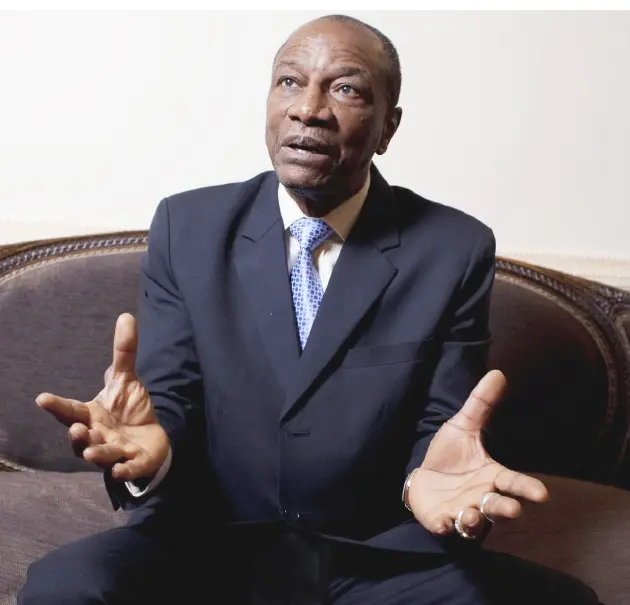
Alpha Conde, Guinea’s Charismatic Leader
Guinea’s President and one of the country’s heroes of democracy, Alpha Conde who clocked 80 on 4th of March is rated
among the continent’s inspiring leaders. His commitment to the development of democracy in his country and Africa as a
whole is unparalleled. His rich credentials, especially in his commitment to democracy earned him the leadership of the
African Union last year. As a political tactician, the Guinean leader won a second term as president in October 2015,
securing victory in the first round of presidential elections with about 58% of votes cast. Condé has been his country’s
top politician and has also been President of Guinea since December 2010. He however faced challenge from opposition
leader Cellou Dalein Diallo, who denounced the vote as fraudulent, and later called for peaceful protests against the
outcome. There was explicit vote of confidence in Guinea’s leader as even the European Union observers said the polls
were valid despite some logistical problems.
Conde, a hero of his country’s democracy in the true sense of the word, became president in 2010 after a lifelong battle
against a series of despotic and military regimes which sent him into exile and prison. It was Guinea’s first democratic
election since gaining independence from France in 1958.
Conde took over from a military junta which seized power after the death of President Lansana Conte in 2008.
However, the vote kindled ethnic tensions, as Conde hails from the Malinke ethnic group, which makes up 35% of the
population. The defeated, Cellou Dalein Diallo, is a member of the Peul ethnic group, to which 40% of Guineans belong.
Mr Diallo has repeatedly accused the president of sidelining his constituents, including many Peul.
In the move to silence Conde, in July 2011, armed men launched an attack on his residence in Conakry, partially
destroying the building, but Mr Conde was unharmed.
In the run-up to parliamentary elections scheduled for 27 December 2011, the opposition accused Mr Conde of attempting
to rig the vote and of failing to consult it about the date. The president, as an avowed democrat, agreed to delay the
vote and pledged to hold an “inclusive dialogue” with the opposition.
The vote was finally held in 2013, with Mr Conde’s political party, Rally of the Guinean People coming close to winning
an absolute majority, with 53 out of 114 seats.
Opposition parties’ alleged fraud, but their attempt to have the result annulled was rejected by the Supreme Court.
Both allies and critics alike acknowledge his charisma and intelligence. His supporters however consider him untainted,
a “new man” who has never had the opportunity to “participate in the looting of the country.”Conde’s political career
began in the 1950s when, as head of the Federation of Black Students in Francophone Africa, he campaigned for
independence from France, a drive that bore fruit in Guinea in 1958.
Considered as one of Africa’s great leaders, Guinean President, Alpha Conde, was saddled with the responsibility of the
chairperson of the African Union (AU) last year. He took over from Chadian President Idris Deby. His election came at
the 28th AU ordinary summit at its headquarters in the Ethiopian capital, Addis Ababa.
One of the remarkable things about the Guinean leader is the improved relations between Nigeria and his country. He had
called President Muhammadu Buhari in London, to wish him good health and speedy recovery while the Nigerian leader was
hospitalized in London.
President Conde, who said he was calling on behalf of leaders of member countries of the AU, assured the Nigerian
President that all African leaders stood with him in prayers at a time like this.
President Buhari, while thanking President Conde for the telephone call, used the opportunity to congratulate him on his
election as AU Chairperson, during the 28th Ordinary Summit of the continental body in Addis Ababa, Ethiopia in January
2017.
While wishing President Conde well, we look forward to a greater ties between Guinea and Nigeria as Guineans look
forward to a more robust economic development under Conde.


Comments (2)
Hmmmmmmmmmmmmmmmm! His rise from exile and imprisonment to the presidency highlights his strong commitment to democracy, although the challenges of political opposition and ethnic tensions remain important aspects of his leadership.
Now,despite his reputation, sustaining unity and trust across different groups will be key to Guinea’s long-term political stability and development.