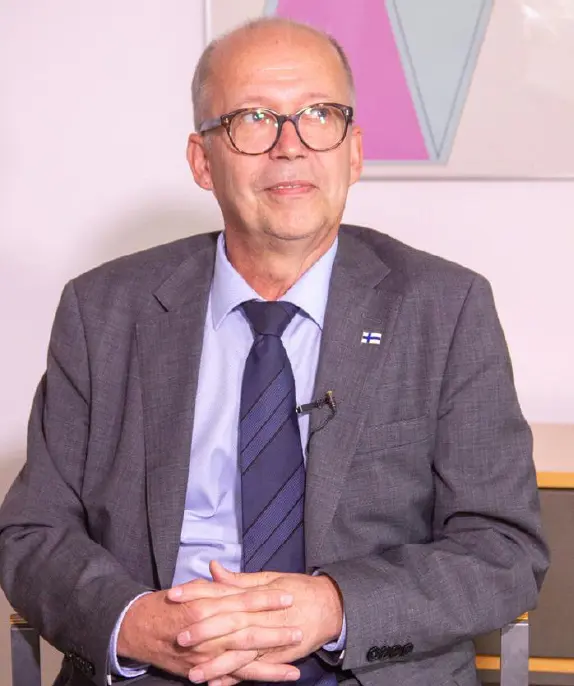
Special Interview:
Finland has interest in Nigeria Nollywood Industry
–Dr. Jyrki Pulkkinen
The relationship between Nigeria and Finland which dates back to 1963 will soon be boosted to include other areas of
mutual interest and benefit to both nations. In this interview with Supremacy Magazine led by the Publisher, Princess
Abigail Amalaha, the Finland’s Ambassador to Nigeria, His Excellency, Dr. Jyrki PulkKinen explains why his country is
interested in the nation’s movie industry, the Nollywood, among other areas of cooperation.
Your Excellency, may you share with us your experience within the short period you have been in Africa’s most populous
nation, Nigeria, as your country’s ambassador?
Thank you very much for coming. So far, I have spent no fewer than ten months in this great country. For the relative
short period I have been here, I have only been to Lagos and here in Abuja, the nation’s capital. I am still getting
used to Nigeria because I didn’t know much about the country before I came here. I had lived in South Africa for two
years; while I spent a year and half in Kenya. Although they are all African countries, their settings are different.
It is on record that Nigeria is one of the earliest countries that Finland established relations with. How would you
describe your country’s relationship with Nigeria?
The relationship between Nigeria and Finland has been very cordial; quite encouraging. Nigeria is one of the foremost
countries Finland established relationship with in Africa. That was in 1963. The relationship has been very warm but not
that busy. We have been looking at how we can sustain and improve the relationship in all spheres. There have been high
level visits by both countries on how to take advantage of the long standing relationship to cement the cooperation.
You have visited some African countries; what are the remarkable differences, if any, among the countries you have so
far visited, with Nigeria?
Like I earlier stated, I have been in South Africa as well Kenya. Most African countries have a lot of things in common,
but the remarkable thing is the infrastructure. I think infrastructure is one of the greatest challenges facing Nigeria.
You cannot compare Nigeria with a population of almost 200 million with these other countries. Due to the huge
population, it is difficult to build infrastructure for all her people. I have been saying that big number of people can
be a challenge and it can as well be your strength. If you educate a large number of people, the population will be your
strength.
In the area of security, Nigeria has its own security challenges, likewise South Africa. It is not easy making
comparison. Every country has their own peculiar challenges but it depends on how the leaders of such country manage
their various problems.
In what ways can Finland help Nigeria in technology transfer?
Well, let’s look at it as knowledge transfer rather than technology transfer. It is not only technology that can be
transferred; there are a lot of other things, especially in the area of learning. We have one of the best educational
systems in the world according to statistics and global research. Education is one of the biggest challenges here in
Nigeria. The issue of education is not only peculiar to Nigeria; Ghana equally has the same challenge.
Another area is that of recycling. There are a lot of wastes in Nigeria, especially plastics which can be recycled and
put into meaningful use; that is, converting wastes to raw materials. Just like the suit I am wearing, it is 50%
recycled plastic bottles and 50% recycled textiles. Another area is that of High-Tech ICT. I believe Nigeria will
benefit from the experience of Finland in the area of ICT.
What areas of future cooperation are the two countries exploring?
Like I earlier mentioned, education, environmental technology, recycling services and high-tech, ICT, can be of special
interest. Other areas like health care services might also be useful here and also sustainable energy solution.
The relationship between Nigeria and Finland has existed for so long whereas the bilateral trade between the two
countries has been so low. How can the trade relationship be improved?
That is the first thing I observed when I came here. In fact I could not comprehend how it is so because Nigeria is the
biggest economy in Africa. Even small countries like Ghana have almost the same trade level. I think there is something
we can do to improve on that. One thing is that Nigerian market is not well known in Finland. Most of our companies are
located in the South, East and North Africa; not in the West. One of the reasons may be because most of the West African
countries are francophone.
Whenever I travel to Finland, I always make out time to engage with some of the chief executives of companies on the
need to invest in Nigeria. The bottleneck is down there, not necessarily here in Nigeria.
What areas do you think Nigerian investors can invest in Finland?
Besides oil, because we have refineries where petroleum can be refined, I think that a very good area is the movie
industry. That is Nollywood. You have the movie industry while we have very good ICT industry, online and the cloud
technology. We can complement each other in these aspects.
Nigeria is a great sporting nation, especially in football. Are you thinking of exploring that area of cooperation in
the future?
Talking of sports, Nigeria is a football nation while the major sports in Finland is Ice Hockey. We have few individual
football players but our teams are not well developed yet.
Can you give us an insight of the number of Nigerians residing in Finland and the peculiar challenges they are facing?
The population of Nigerians in Finland is very small, may be two or three thousand. I don’t think we have challenges
with Nigerians. Most of them are working in different industries and they are doing well. The big problem in Europe is
illegal immigrants, but most of them in Finland are not from Nigeria.
Finland has one of the highest literacy ratio in the world which has translated into quality living. How can Nigeria
with high illiteracy ratio benefit from your country?
Illiteracy can be broadly understood. We have media illiteracy, ICT illiteracy as well as educational illiteracy. As I
said earlier, our educational system is one of the best in the world and I think Nigeria can benefit from our mode of
educational system. You can develop your educational system by starting from the cradle, that is, the primary and
secondary level. Nigeria can understudy our educational system to improve on what already exists here. Another aspect is
that we can work out an educational exchange programme. It is important to get the young people educated so that they
can be more useful to the society and be creative.
Finland was recently ranked first in the Good Country Index based on the overall impact of the country on the planet.
What does the ranking mean to your country?
Well, it is also part of diplomacy. If you are doing good to other nations, it pays back in the long run will. We have
been doing good to other countries as reliable and trusted partners. If that has given Finland good position in the
world, it means other countries trust us. The ranking will boost us to continue doing good since what we are doing is
being recognized and appreciated.
Can you give us an insight into the recently held World Circular Economy Forum that took place in Helsinki, Finland? How
can African nations benefit from such Forum?
The Forum is something Finland has been planning to organize even before we took over the leadership of European Union
(EU). The Forum looks at innovations, economic opportunities, how to sustain our environment, amongst other issues. Like
I said earlier, we want to recycle; we want to reduce waste and to make our environment safe. The Circular Economy is
mostly centered on that.
The Forum attracted a lot of participants from across the globe including Nigeria which was well represented. We
specifically invited Nigeria. The area of waste management and recycling of waste are important aspects Finland and most
European nations will be interested to partner with Nigeria and Africa.
Africans will have a lot to benefit from the Forum through collaboration. I think Africans can be more involved in the
Forum. It will be good to have similar Forum in Africa. May be, the next Forum will be held in Africa. If Africans are
ready to organize it, am sure the Europeans will support them, but they will not have to force it on Africans.
How do you see our local delicacies? Have you tasted any?
Your food is excellent. African foods are excellent. I love grilled meat. I also love jollof rice. I love suya. My mouth
likes it but I don’t know whether my stomach likes it, because of the pepper. There are so many other local dishes I
have not tasted. Possibly, in the next few years, I might be able to taste them.


Comments (2)
What I cann say, The interview highlights Finland’s ambassador showing genuine curiosity about Nigeria and Africa, especially in areas like education, recycling, and ICT. There’s a strong emphasis on cooperation rather than criticism, which makes the conversation feel diplomatic and forward-looking. However, the discussion sometimes feels overly idealistic, especially when talking about solving deep issues like infrastructure and education through simple collaboration.
Nice interview to me. The dialogue reflects a strong focus on knowledge sharing between Finland and Nigeria, particularly in education reform, environmental sustainability, and technology transfer. The ambassador presents Finland as a model system, especially in recycling and education. Still, the comparison between both countries can feel one-sided at times, with less attention given to Nigeria’s existing strengths and complexities.